Streaming platforms’ Terms of Service (ToS) universally prohibit the downloading of content without explicit authorization. For instance, YouTube’s ToS explicitly states that users shall “not download, copy, or otherwise store any Content” unless given permission via a “download” link provided by the platform. ByClick directly facilitates a violation of this contract. Furthermore, downloading copyrighted material—such as Hollywood movies, commercial music videos, or licensed TV shows—constitutes copyright infringement under laws like the US Digital Millennium Copyright Act (DMCA) and EU Copyright Directive.
In the contemporary digital ecosystem, streaming platforms like YouTube, Vimeo, and Dailymotion have become the primary repositories of human expression, education, and entertainment. Yet, these platforms operate on a fundamental paradox: they offer instant access to vast libraries of content while simultaneously rendering that content ephemeral, locked behind proprietary interfaces and streaming protocols. Enter the browser extension—a lightweight software module designed to augment functionality. Among these, the ByClick Downloader extension stands out as a controversial yet powerful tool. This essay provides a detailed examination of ByClick Downloader, exploring its core functionality, user value proposition, technical architecture, legal and ethical implications, and its place within the broader context of digital ownership. Core Functionality and User Experience At its most basic level, the ByClick Downloader extension is a client-side software add-on, typically integrated with major web browsers like Chrome, Firefox, or Edge, that facilitates the downloading of video and audio content from streaming websites. Unlike many competitors that offer limited resolution or require convoluted copy-pasting of URLs, ByClick’s primary innovation lies in its seamless integration. Once installed, the extension embeds a downloadable button directly onto the streaming page itself—often adjacent to the video player. byclick downloader extension
Ultimately, ByClick Downloader is a technically proficient solution to a legal and ethical problem. It empowers users with the forgotten right to permanently possess digital media, yet it does so in defiance of the contractual and copyright frameworks that underpin the modern internet. As streaming services continue to raise prices, delete content for tax write-offs, and restrict sharing, the demand for tools like ByClick will only grow. The extension serves as a digital archivist for the common user, but one that operates in a permanent state of civil disobedience—a powerful, convenient, and deeply controversial key to the walled gardens of the web. with outcomes varying by jurisdiction.
This two-pronged architecture is crucial. The browser extension provides the user-friendly interface, while the desktop backend manages the complexities of HTTP range requests, decryption of proprietary streaming protocols (like YouTube’s cipher signature), and error handling. Compared to purely online downloaders, ByClick is generally faster and more reliable, as it avoids server-side bottlenecks. Compared to open-source command-line tools like youtube-dl , ByClick sacrifices granular control for a polished graphical user interface (GUI) and automated updates to counter platform anti-download measures. The most contested aspect of the ByClick Downloader extension is its legality and ethical standing. The software operates in a legal gray area globally, with outcomes varying by jurisdiction. Compared to purely online downloaders
Kali + Additional Tools + Vulnerable Applications in Docker containers...
A vulnerable VM that you will use to perform a full assessment (from reconnassaince to full compromise)
Another vulnerable VM that you will use to perform a full assessment (from reconnassaince to full compromise)
This video explains how to setup the virtual machines in your system using Virtual Box.
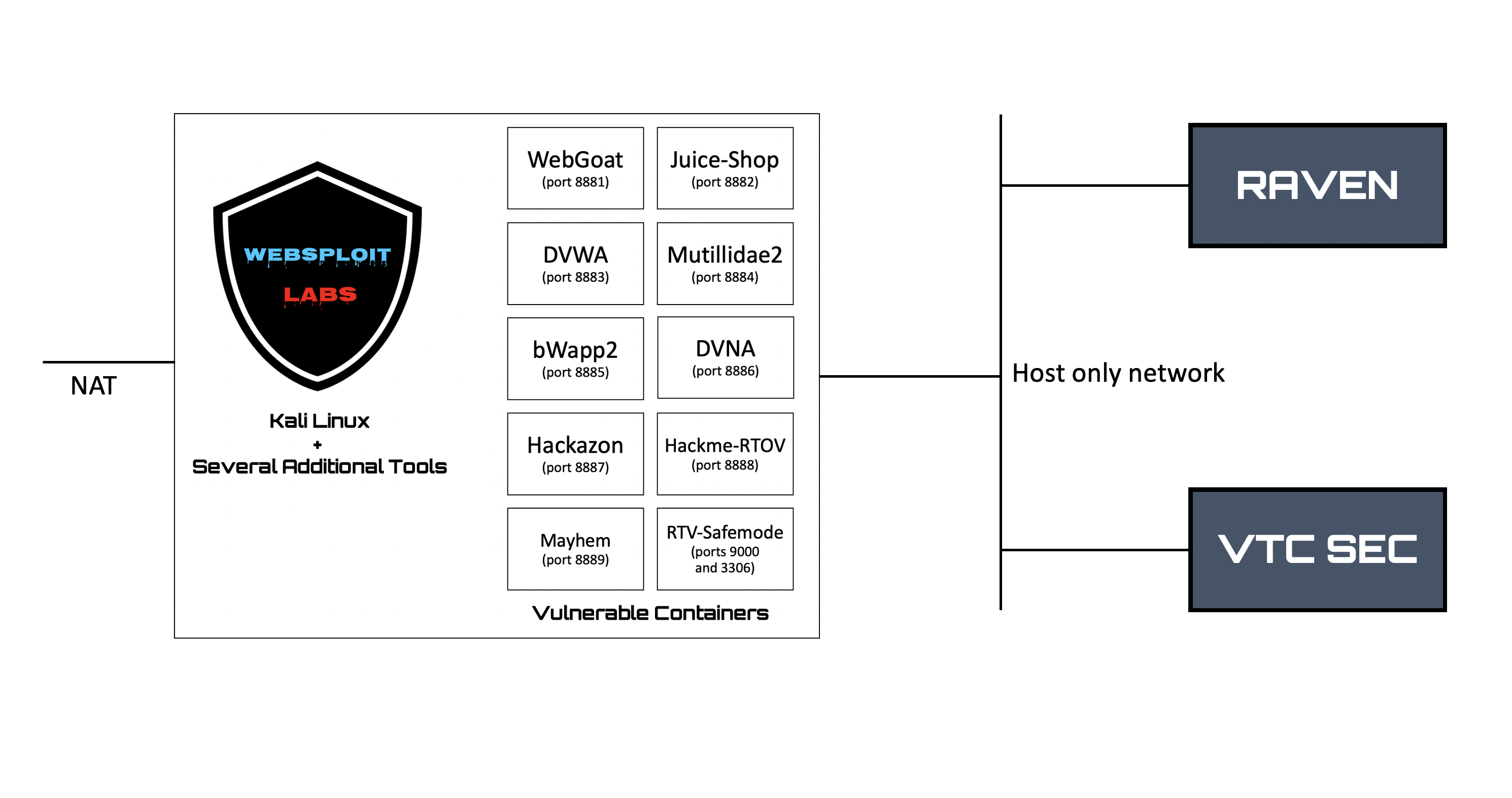
The diagram below shows the lab architecture with WebSploit Full version, Raven, and VTCSEC. The VMs were created in Virtual Box. It is highly recommended that you use Virtual Box. However, if you are familiar with different virtualization platforms, you should be able to run the VMs in VMWare Workstation Pro (Windows), VMWare Fusion (Mac), or vSphere Hypervisor (free ESXi server).
You should create a VM-only network to deploy your vulnerable VMs and perform several of the attacks using WebSploit (Kali Linux), as shown in the video above. You can configure a separate network interface in your WebSploit VM to connect to the rest of your network and subsequently the Internet. Preferably, that interface should be in NAT mode.
Stay in Touch with Omar!