

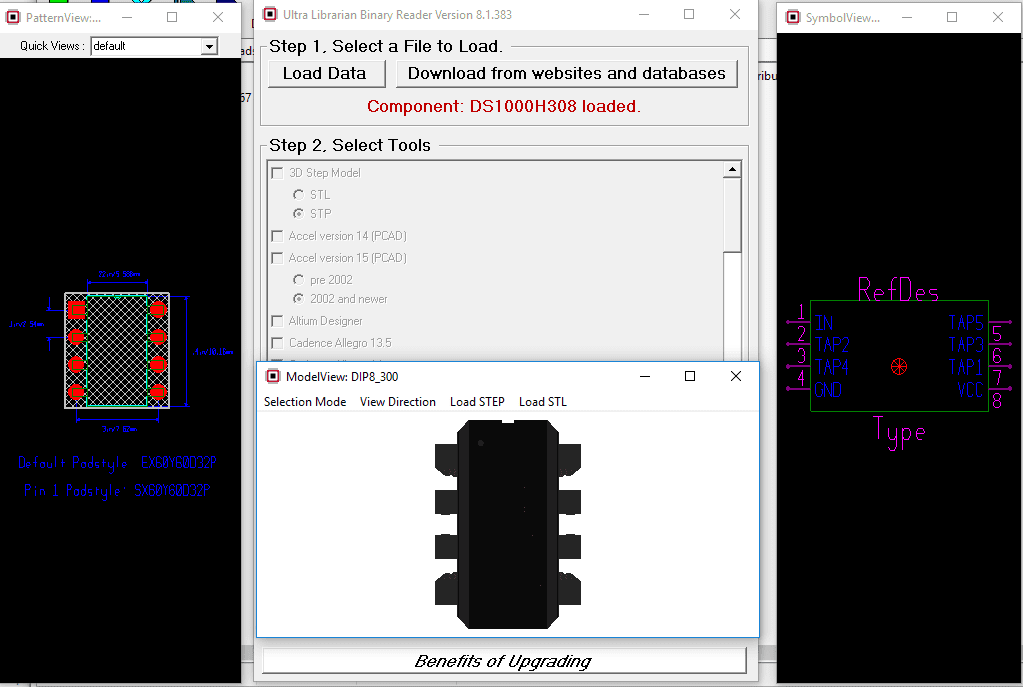
CREATE SYMBOLS, FOOTPRINTS, AND 3D MODELS FROM PRE-AUTHORED DATA

ULTRA LIBRARIAN FREE READER

Preview models prior to downloading

Choose from over 20 different CAD export options

and just like that s01e03 bd50
CONVERT BXL FILES INTO YOUR PREFERRED CAD FORMAT

The free reader is a lite version of Ultra Librarian specifically designed to import vendor neutral CAD data (.bxl files) from manufacturers’ websites and then export symbols, footprints, and 3D models to specific CAD tool formats. The reader is a read-only tool and will not allow users to make any changes to the data. For symbols, footprints, and 3D model creation capabilities, use one of the Ultra Librarian Desktop Software options.

BXL FILES FROM YOUR FAVORITE IC MANUFACTURERS

Many of our IC partners offer BXL files for their components directly on their websites. Once you have obtained a BXL file it is quick and easy to convert to your preferred CAD format through our online BXL conversion tool.

Check out all manufacturers here.

EXPORT TO OVER 30 DIFFERENT CAD FORMATS

VENDOR NEUTRAL FILES

Accel EDA 14 & 15

  • DesignSpark
  • Mentor Graphics
  • BoardStation
  • Mentor Graphics Design Architect
  • Mentor Graphics Design
  • Expedition 99 and 2000
  • PCAD 2000, 2001, 2002, 2004, and 2006
  • STL
  • TARGET 3001!
  • View Logic ViewDraw
  • Zuken CadStar 3 and 4
  • Zuken CR-5000 and CR-8000

FREQUENTLY ASKED QUESTIONS

A .BXL file contains electronic data created by Ultra Librarian in a universal format and is used for distributing PCB information. .BXL files can be opened by the Ultra Librarian Free Reader and translated into your choice of 22 different CAD formats.

Ultra Librarian has partnered with major IC manufacturers to create electronic data representing their parts and are available to the public. Partners include Analog Devices, Texas Instruments, Microchip, Maxim, Silicon Labs, Renesas, Exar, and NXP.

Yes, you can use our Online Reader if you don’t want to download the Free Reader

Free Reader

"*" indicates required fields

And Just Like That... S01E03, “When in Rome…,” is an episode about the spaces between data points: the silence between voicemail beeps, the pixels of a paused video, the empty gigabytes of a dead man’s hard drive. The BD50 format, far from being a mere technical specification, is the ideal vessel for this story. Its high bitrate preserves the granularity of performance, its lossless audio captures the haunting intimacy of absence, and its physicality stands as a quiet rebellion against the very streaming culture that birthed the series. To watch this episode on BD50 is to understand that grief, like high-definition video, is unforgiving: every crack in Carrie’s composure, every digital scar on Big’s final message, is held, unflinchingly, in focus.

Episode 3 is where the shockwave of Mr. Big’s death in the premiere fully materializes. Carrie Bradshaw, having numbed herself with routine and avoidance, is forced to confront the administrative and emotional wreckage of widowhood. The episode’s title, “When in Rome…,” ironically underscores Carrie’s alien status in her own life—she is a stranger to the rituals of death, to the digital logistics of probate, and to the suddenly foreign landscape of her own apartment. The narrative hinges on her retrieving Big’s ashes and, in a devastating final scene, listening to his voicemail greeting on repeat. This is not a story of grand gestures but of granular pain: the way grief lodges in voicemail inboxes, laptop passwords, and the silent Peloton bike in the corner.

There is a profound irony in watching a series about digital-age dislocation (Carrie struggles with texting, podcasting, and password recovery) on a physical disc. The BD50 represents a bulwark against the very ephemerality that haunts the episode. Streaming services can remove or alter episodes; bitrates fluctuate with bandwidth. But the BD50 is fixed. When Carrie listens to Big’s voicemail on repeat, she is trying to freeze time, to hold onto a digital ghost. The viewer, by choosing the BD50, engages in a parallel act of preservation. We reject the compressed, transient stream in favor of a permanent, high-fidelity object. The disc becomes a memorial—not just for Mr. Big, but for the very idea of media permanence.

Furthermore, the BD50’s ability to handle complex color gradients is essential. The episode’s color palette shifts from the warm, golden hues of Carrie’s memory-drenched apartment to the sterile, cold blues of the funeral home and the lawyer’s office. On a low-bitrate stream, these transitions can muddy into grey. On disc, the contrast is sharp and intentional: warmth signifies the past, coldness the present. The disc’s high-frequency video layer ensures that this visual language is communicated without loss.

the pcb design, assembly, and trends blog

RELATED CONTENT

And Just Like That S01e03 Bd50 -

And Just Like That... S01E03, “When in Rome…,” is an episode about the spaces between data points: the silence between voicemail beeps, the pixels of a paused video, the empty gigabytes of a dead man’s hard drive. The BD50 format, far from being a mere technical specification, is the ideal vessel for this story. Its high bitrate preserves the granularity of performance, its lossless audio captures the haunting intimacy of absence, and its physicality stands as a quiet rebellion against the very streaming culture that birthed the series. To watch this episode on BD50 is to understand that grief, like high-definition video, is unforgiving: every crack in Carrie’s composure, every digital scar on Big’s final message, is held, unflinchingly, in focus.

Episode 3 is where the shockwave of Mr. Big’s death in the premiere fully materializes. Carrie Bradshaw, having numbed herself with routine and avoidance, is forced to confront the administrative and emotional wreckage of widowhood. The episode’s title, “When in Rome…,” ironically underscores Carrie’s alien status in her own life—she is a stranger to the rituals of death, to the digital logistics of probate, and to the suddenly foreign landscape of her own apartment. The narrative hinges on her retrieving Big’s ashes and, in a devastating final scene, listening to his voicemail greeting on repeat. This is not a story of grand gestures but of granular pain: the way grief lodges in voicemail inboxes, laptop passwords, and the silent Peloton bike in the corner. and just like that s01e03 bd50

There is a profound irony in watching a series about digital-age dislocation (Carrie struggles with texting, podcasting, and password recovery) on a physical disc. The BD50 represents a bulwark against the very ephemerality that haunts the episode. Streaming services can remove or alter episodes; bitrates fluctuate with bandwidth. But the BD50 is fixed. When Carrie listens to Big’s voicemail on repeat, she is trying to freeze time, to hold onto a digital ghost. The viewer, by choosing the BD50, engages in a parallel act of preservation. We reject the compressed, transient stream in favor of a permanent, high-fidelity object. The disc becomes a memorial—not just for Mr. Big, but for the very idea of media permanence. And Just Like That

Furthermore, the BD50’s ability to handle complex color gradients is essential. The episode’s color palette shifts from the warm, golden hues of Carrie’s memory-drenched apartment to the sterile, cold blues of the funeral home and the lawyer’s office. On a low-bitrate stream, these transitions can muddy into grey. On disc, the contrast is sharp and intentional: warmth signifies the past, coldness the present. The disc’s high-frequency video layer ensures that this visual language is communicated without loss. Its high bitrate preserves the granularity of performance,